Transforming News
Rethinking leadership in the age of AI
As artificial intelligence continues to reshape our world, the most important question may no longer be “How can we compete with machines?” but rather:
“How can we become more fully human, thanks to them?”
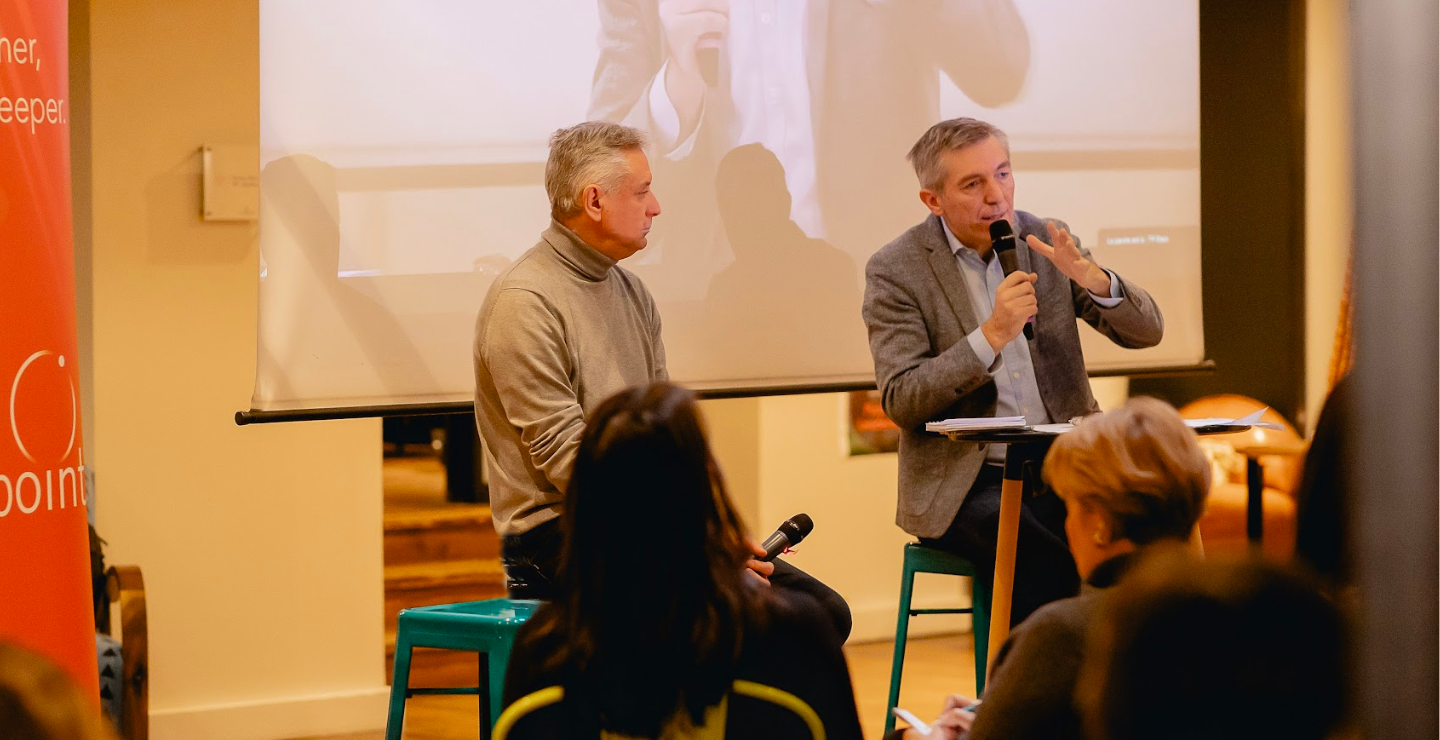
In this enlightening podcast, Olivier Pelleau, Turningpoint founder and former philosophy professor, and Pierre-Yves Gomez, emeritus professor at EM Lyon, explore the seismic shifts AI is driving in organizations, jobs, and the long-term creation of value.
Key takeaways:
Instead of viewing AI as a competitor or a threat, they invite us to consider it as a mirror—a powerful reflection that challenges us to reconnect with the essence of what makes us human. In this light, AI becomes not an opponent to outsmart, but a catalyst that sharpens our most vital human capacities.
Olivier Pelleau identifies five of these core human qualities—capabilities that no algorithm can authentically replicate, no matter how advanced the technology becomes:
Creativity – not merely generating ideas, but weaving them together in meaningful, original ways to solve real-world problems.
Intuition – the subtle ability to sense what data can’t reveal, to detect weak signals, and to take bold, sometimes non-rational decisions.
Critical thinking – the courage to engage with complexity, question assumptions, and navigate through ambiguity and contradiction.
Ethics – the capacity to discern what is right, just, and appropriate within a given context—not based on rules alone, but on values.
Philia-love – the unique ability for intentional care, an active commitment to doing what’s best for others, going beyond efficiency, self-interest, or logic.
These aren’t just soft skills, they are, as Olivier Pelleau puts it, human « superpowers ». And in an age increasingly governed by automation, data, and algorithms, they are not optional: they are indispensable.
There’s no shortage of dystopian fears about machines taking over decisions. But Pierre-Yves Gomez offers a crucial reminder: AI doesn’t act independently. It doesn’t decide. It doesn’t care. It responds to inputs. It accelerates processes. But it lacks intention, perspective, and moral judgment.
In that sense, its intelligence is instrumental, not existential. The risk is not that AI will take control, but that we might abdicate ours.
That’s why the real challenge for leaders today is not just to understand AI—but to learn how to think with it, critically and consciously. To leverage its strengths without surrendering human responsibility. To remain the moral and creative authors of the decisions that matter most.
AI, then, doesn’t necessarily dehumanize us. On the contrary, if we engage with it wisely, it can be a force that re-humanizes us—by drawing us back to what only humans can truly do: imagine, care, discern, and lead.
Let the machine do what it does best. And let us do what only humans can: lead with heart, depth, and purpose.
Enjoy the podcast (in French!)

Inspiring News
Podcasts series by Turningpoint co-founder Bridget Farrands
Transforming News
An article co-created by four leaders at Turningpoint: Véronique Girma, Global Managing Partner,…
Inspiring News
Inspiring News

Inspiring News
In a world driven by rapid technological progress, stepping back to think and decide deliberately is…
Turningpoint’s approach to transformation is based on the systemic, appreciative and narrative methods of resource-oriented collective intelligence, as opposed to the more traditional corrective approach. These approaches and tools can be deployed for teams and large groups.





Turningpoint specializes in executive individual and group leadership and coaching and development.