Inspiring Opinion
The challenge for leaders, and executive coaches, in the age of AI.

Founder, Managing Partner, Senior Executive Coach
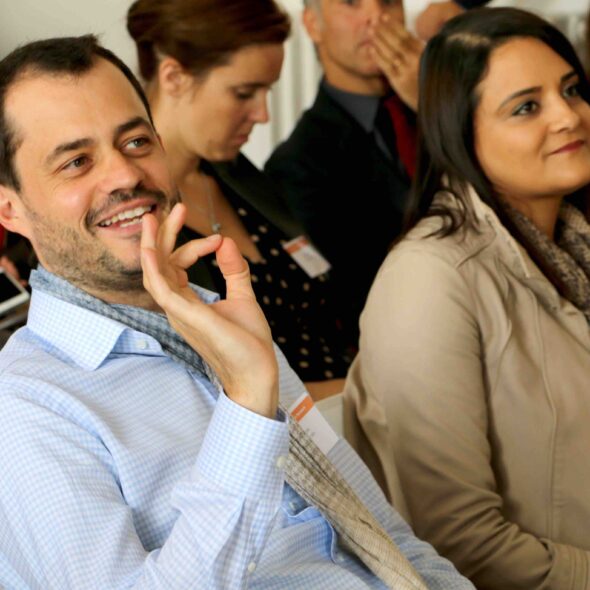
At the 2026 TP Days, Turningpoint’s coaches and operational teams reflected on the impact of the AI revolution on leadership itself: how exactly is AI reshaping what it means to lead? This was an opportunity to step back, understand the historical moment we are living through, and revisit the coach’s role in this cultural shift that is redefining humanity, and especially leadership, amid AI’s growing influence.
At the end of the Renaissance, Descartes laid both the foundation and the intent of modernity in his famous Discourse on Method (1637): freeing humans from all forms of religious, political, or natural dependence by “becoming like master and possessor of nature.” A century later, Emmanuel Kant reaffirmed this ambition, urging humans to think for themselves: “Have the courage to use your own understanding.” This quest for autonomy, rejecting any form of external dependence, profoundly shaped modern thought in France, Germany, and Great Britain, eventually spreading worldwide. For Kant, the emblematic philosopher of the 18th century, “Enlightenment is man’s emergence from his self-imposed immaturity.”
Modern thought was built on a radical separation between body and reason. Following Plato, Descartes claimed that only the consciousness of one’s own thought guarantees certainty, dismissing the body, emotions, and sensations as sources of error: cogito ergo sum. This vision shaped the Western modern human, marked by the opposition between analytical reason, which understands physical phenomena, and bodily, sensory, and emotional dimensions, which were seen as subjective and relegated to the background.
The 18th-century scientific advances; mathematics, physics, chemistry, biology, compiled in Diderot and d’Alembert’s famous Encyclopedia paved the way for the Industrial Revolution. Machines promised to free humans from the drudgery of production. In this race for productivity, nature became a resource, first coal, then oil, and later nuclear energy. The individual, seeking to dominate nature, gradually became a cog in this vast machine.
Politically, modern thought also sought freedom from dependency. Cultural roots, affective ties, and community affiliations were seen as constraints to escape. The Le Chapelier Law of June 14, 1791, banned guilds, associations, and early unions to suppress intermediary bodies and enforce a direct, singular relationship between the citizen and the state.
Today, humanity stands at a historical turning point. In trying to surpass nature to gain freedom, modern humans have multiplied their capacity for action, only to be outpaced by their own technological creations. This overextended power exceeds human control and challenges our freedom. The hyper-autonomous individual paradoxically finds themselves vulnerable and overwhelmed by excessive information, choices, and isolation.
Artificial intelligence is no longer just a tool; it has become an environment. Through our glasses, our cars, and our information flows, AI influences our decisions subtly and unconsciously. We no longer need to sit in front of a computer to interact with it, we are immersed in its world. A shift is occurring: tools that once extended our hands and minds now risk surpassing our own intelligence.
With its computational power and algorithmic opacity, AI is becoming less controllable by human intelligence. Once a tool to amplify human power and free us from natural, political, or economic dependencies, it is increasingly autonomous, soon potentially competing with humans. Programmed to achieve human goals, our drive to “persist in being”, might AI, in turn, strive to “persist as AI”?
This is not a fatal scenario. On the contrary, it presents an extraordinary opportunity: rediscovering what it means to be human, not as a rational machine, but as a vulnerable, relational being with emotions, a body, and intuition. Aristotle reminds us that intelligence is more than reasoning: it is also the capacity to discern what is just and good, a “refined tip of the soul.” Our era calls for a return to this living intelligence.
Coaching today means guiding this return to purpose and the exercise of discernment through true inner freedom and strong critical thinking. Coaches help leaders break free from the productivity reflex ingrained over centuries, re-engaging consciousness, emotion, and relationships. They challenge leaders who have become fixated on optimizing ratios, KPIs, or stock prices, encouraging holistic engagement: intellectual, emotional, physical, spiritual.
In a tech-saturated world, where AI is the new Prometheus with near-omniscience and omnipotence, coaching assumes a new mission: nurturing what is most distinctively human, and what no technology, no matter how powerful, can take away: our capacity for humanity. Beyond the constant streams that capture our attention and disconnect us from ourselves and others, tomorrow’s leaders must relearn to engage their five senses, feel their bodies, imagine, marvel at beauty, exercise critical thinking, intuition, and discernment, commit courageously, and ultimately love with the intentional pursuit of the good of others.
Being human is not a slogan; it is a project. AI can either erode our humanity or reveal it. It is up to us, especially leaders, to cultivate inner freedom to rebuild a sensitive, grounded, and connected humanity, resisting the temptation to reduce ourselves to mere machines among machines.
The path is clear: develop critical thinking, nurture relationships, inhabit our bodies and freedoms fully. For leaders, this is a journey toward ever greater humanity. Guiding others on this journey is, more than ever, the essential mission of executive coaches.
R. Descartes, Discourse on the Method, Part 6, 1637.
E. Kant, What Is Enlightenment?, 1784.

Inspiring Opinion
What AI reveals about the limits of human development work, and what it can never replace.

Inspiring News
In a world driven by rapid technological progress, stepping back to think and decide deliberately is…

Coaching Opinion
What 15 Years of coaching have taught me about leadership transformation.

Inspiring Opinion
Including women in decision-making roles isn’t optional, it’s a strategic imperative.

Inspiring Opinion
Would de Gaulle have been de Gaulle were it not for the World War II armistice? Would Gandhi have…
Turningpoint creates enriching encounters to enable teams and communities to project themselves into future challenges. By confronting their views, these exchanges allow them to let themselves be inspired and reinvent their view of the world.





Turningpoint specializes in executive individual and group leadership and coaching and development.